Tuesday, June 1, 2010

Landscape and Narrative: Using Victor Sjostrom's Early Films as a Case Study


This post forms the "head" for an exploration of landscape in narrative, and with a heavy emphasis on narrative in film. While many of my arguments stem from a close look at the use of landscape in Victor Sjostrom's silent films, they use elements of Sjostrom's films also as illustrations of what landscape generally can do within the context of the moving image, the motion picture. Why use Victor Sjostrom's work? Partly I have a desire to see his name fixed more prominently amongst the great filmmakers of our age; many are familiar with D. W. Griffith, Charlie Chaplin, etc, but Sjostrom rarely enters prominently into a discussion of the early great auteur filmmakers. Nevertheless, Andrew Sarris (the man who popularized the "auteur theory" in America) wrote of Victor Sjostrom that he was possibly "the world's first great director, even before Chaplin and Griffith." Why was he great? Sjostrom came to film from the theatre, and developed characters and situations that had great depth and emotional significance, as with one of his first acclaimed works, the 1913 film Ingeborg Holm. But in addition to Sjostrom's nuanced sensibilities about character and story, he also introduced natural elements into his films that brought the spectacle of the natural world to a level rarely achieved before, or after. His films A Man There Was and The Outlaw and His Wife, released in 1917 and 1918, were at the time described as "the most beautiful films in the world." Sjostrom brought subtlety and beauty to the mise en scene of the natural world, surpassing the sort of place-holding role that setting and set design had been relegated to in a transitional period between the prominence of a "cinema of attractions" and the triumph of the feature film. Consider the opening sequence of A Man There Was, and how powerfully Sjostrom uses the natural world (and note that it is Victor Sjostrom himself in the title roll):


I am a lover of outdoor spaces, of big skies and distant horizons, of the sublime grandeur of mountain ranges and the infinite repetition of waves in a choppy sea. And while this love is personal, and forms the impetus for my exploration of landscape in media, it is also communal, as it follows a general societal impulse to see the world's awe-inspiring natural locations, whether in person or vicariously through whatever medium may be available. We can find, for instance, in an early silent film produced by
Thomas Edison, a short film of a natural setting in which no specific action takes place other than the motion of the train and of the water roaring by in the gorge outside the train's windows.


Audiences flocked to see these types of films, called "phantom rides," "scenics," "travel films," "travelogues," or "foreign views." There are clearly echoes of the "travel film" in
A Man There Was...but Sjostrom takes the camera's ability to capture natural spectacle and weaves it into a story that uniquely benefits from the union. He did this at a time when many films had removed from natural settings, because of the expense of transporting actors and film crew and for concerns about weather and disruption of extremely tight shooting schedules.

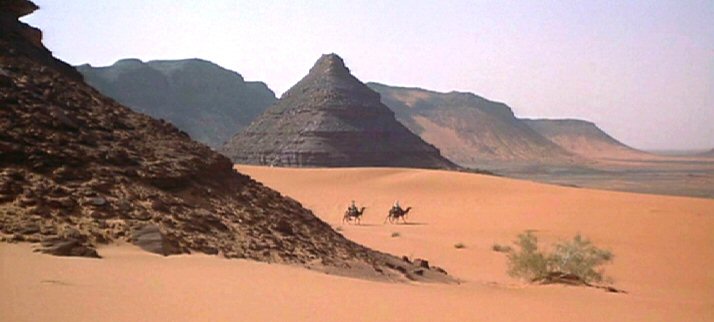
The many terms synonymous with "travel film" is indicative of the huge volume of such films that were produced in the early days of film, generating copious descriptions and labels. And it is clear that natural locations are still important in film, that they strike a chord in audiences in ways that deserve to be explored further. We might look at a scene from Lawrence of Arabia, for instance, and note the ways that the framed depictions of a desert world worked to create one of the most celebrated films of all time. In a more current example, we might consider moments from Baraka, a film that was filmed in 152 locations in 24 countries, and that was neither cheap nor easy to make.


Why make it? Because it was meaningful both for the filmmakers, and for the audience, just as Edison's film from 1900 was. The fact is, that along with narrative stories and action and events, both historical and modern audiences are drawn to landscapes.

The popular affinity for the grandeur of our world is a sensibility that Victor Sjostrom tapped into. But I argue that landscape in film is much more than a pretty thing to entrance us. Martin Lefebvre, Associate Professor in the Mel Oppenheim School of Cinema, Concordia University, Montreal and author of
Landscape and Film, says that "landscape is everywhere in film, but it has been largely overlooked in theory and criticism...What kind of landscape is cinematic landscape? How is cinematic landscape different from landscape painting?" Lefebvre poses such questions in his volume, and I hope to articulate a response that enriches the discussion. I also intend to note differences between the use of landscape in literature and the use of landscape in film.

Ultimately, it is my view that developing an understanding of the way landscape can work within a text will aid the modern viewer in determining valuable aspects of visual aesthetics, especially aesthetics in film. I also suggest that this understanding may help modern viewers to be reflective and discerning in consuming media, so that the viewing process is one of growth, rather than cheap thrills or stagnation.

The following points delineate the different areas that I will consider in my exploration of and arguments about landscape:

1. A historical look at the transition period between the "cinema of attractions" and the feature film
2. The biography of Victor Sjostrom and the events that led him to consider his natural environment as an important aspect of his films.
3. A comparison using film clips of Victor Sjostrom's films and representative films of the same time period.
4. A historical look at the way that landscape has developed in art and literature, and in film, and an analysis of the differences between them.
5. An extrapolation of Roland Barthes' thoughts about "Readerly" and "Writerly" texts to the film paradigm, and the ways that landscapes can promote the creation of a "writerly" text.
6. Personal experiences in creation of landscape painting and film that inform my thoughts about landscape
7. Theorists and texts that might add to the discussion that I have not yet explored.

Edit 6/15/2010: I reformulated ideas generated in this exploration in a new hub-post that crystallized my thinking and went in some new directions.

Friday, May 28, 2010

People who I disagree with


I am still struggling to rip the scenes I need from My Sjostrom DVD, so in the meantime I'll share a bit about landscapes from two online writers that I disagree with.

To start, I found Stewart McKie's article on Sys-Con Media, titled "The Role of Landscape in Film." He lists some of my favorite movies: Lawrence of Arabia, Dances with Wolves, Aguirre: The Wrath of God, etc., and goes on to describe the ways in which the landscapes within them "add additional depth to a story or the situation that characters find themselves in." I don't have a problem with that statement. In fact, I'd agree with most of what McKie says, when he includes a list of ways that landscapes can work in film:

  • Reinforce themes
  • "Raise the stakes"
  • Create emotional highs
  • Emphasise contrasting worlds
  • Act as a character in its own right

But he leaves out an important element that I think Martin Lefebvre is keen to observe in the introduction to his volume, "Landscape and Film." Lefebvre's essential addition is that observation of landscapes often results in a removal or break from the narrative, because it privileges the aesthetics over the plot. McKie only discusses landscapes in ways that are more immersive to the viewer in the world of the story, if not the story itself. He sees landscapes not as opportunities for pause from narrative, but as extra tools to maintain the film's pull on the viewer, to root them in the story. I don't deny that what McKie says can happen, but I don't think landscape is always or merely an immersive element.

Yet again as I sought another online writer, I found Renee, a blogger and film-maker who again sees landscape as an opportunity to latch ever more strongly to the "world" or "atmosphere" of the story. In her case, she speaks of having worked on the movie "Twilight" as a painter, and discovered the ways that landscapes were so powerful to people. There is a real town called "Forks" on which Twilight fans have descended, because as Renee puts it, the land and landscape are a way to "enter into the story through a real-world portal." And that's something they tried to recreate on the set of Twilight.

So I'm bumped up against the question that challenges my assertion: Does landscape really immerse us more in the story, or does it offer us an opportunity to step back from it? Or both?


Tuesday, May 25, 2010

The Digital Millenium Copyright Act (DMCA)


I finally got my copy of Victor Sjostrom's "Terje Vigen" in the mail, and have been preparing to upload some clips to youtube to demonstrate Sjostrom's use of landscape. However, I've run into some ethical/legal issues that I simply don't have the answers to. Basically, I can't tell if it is legal to copy clips from the DVD to upload to youtube. I've done a fair amount of research, but haven't been able to find a definitive answer yet.

Here are some of the things I've been able to determine, some being confounding factors:

1. "Terje Vigen" was "published" before 1923, and so would appear to be in the public domain, and fair to copy and use clips of. However, the DVD version that I have obtained indicates that it was created using a version discovered and restored in 2004, at which time a new soundtrack was also added. On the DVD case, it indicates: "Copyright" in 2008 to Kino INternational Corp.

2. In general, it appears to be illegal to bypass any copy-protection program (DRM)included in any electronic medium. Most recent media should have these features. Mine probably does. There is an exception: "Audiovisual works included in the educational library of a college or university’s film or media studies department, when circumvention is accomplished for the purpose of making compilations of portions of those works for educational use in the classroom by media studies or film professors. (A new exemption in 2006.)" But does this apply to me?

3. As far as uploading works that someone else has the rights to, youtube says "don't do it." Since it is not a legal service, youtube does not explain what the legal ramifications are, only that it may remove the video or terminate your account. But is it okay to upload something and keep it up if nobody ever contacts you to take it down? Youtube's policies basically make it clear that the copyright holder must contact them to remove content, and that a suit is possible. But if you take it down when asked, is the suit probable? And have you done something wrong?

4. Youtube does indicate that there are "fair use" possibilities even for copyrighted material, but can't say what those are. At the government site they link, it says "fair use" could include: "the reproduction of a particular work may be considered fair, such as criticism, comment, news reporting, teaching, scholarship, and research." It sets four general guidelines for determining this fair use, but I can't tell where using something like a 5-minute clip falls in there. In fact, the government site indicates that "The distinction between fair use and infringement may be unclear and not easily defined." It does indicate moments when a student might use copyrighted material. Is this one of them? And would I need to take the video down when the course was over?

5. It is possible that the youtube video of Lawrence of Arabia that I uploaded was not posted on youtube legally/appropriately. Is it okay for me to link to it? What about other videos with similar questionabless?

If you have any helpful advice, please weigh in. This is probably important info for all of us as we consider fair use with new media and new technology. I got the image from freefoto.com.

Monday, May 24, 2010

The Landscape View

As a way of preparing the kinds of questions I want to include in a poll or survey for the specific film I am looking at (Terje Vigen/A Man There Was), I want to take look at a more modern (and accessible) film of at least equal acclaim. Enter Lawrence of Arabia.

This clip is about 3 minutes long, but you could get by on just watching the first minute and ten seconds. Lawrence of Arabia is acclaimed for its cinematography and beautiful setting. But is that all the natural elements are? Setting? Consider this quote from Martin Lefebvre:

"The birth of landscape should really be understood as the birth of a way of seeing, the birth of a gaze by which what was once in the margin has now come to take its place at the centre."

I argue that narrative prioritizes action and plot while consideration of aesthetics requires a pause, an introversion that steps aside from story. It is on the side of aesthetics that we should place landscapes.

But as you watch this clip from Lawrence of Arabia, does your mind stay aesthetically tuned? Or does it seek out plot as well?

Again, Martin Lefebvre says: "Landscape in narrative film possesses the peculiar ability to appear and disappear before the spectator's very eyes."

So, please watch this clip, and respond as you see fit. Gut responses are fine, because part of what I'm arguing is what landscapes do to us without us realizing it. If you'd like some question prompts, here are a few:

1. What do you think is the meaning of the clip in the first minute?
2. What attracts your attention?
3. Are you more or less engaged in the scene in the first minute, compared to the bits of plot that follow shortly thereafter?
4. What is the difference in your experience of watching the clip before the introduction of plot elements, and after?
5. What do you think about or wonder as you watch the first minute? What do you think about or wonder after the plot elements have been introduced?
6. Does your "view" or "gaze" change over time as the video clip plays?

Here is the video clip:


If you'd like to be able to watch the clip larger, here's the link to the youtube clip "Great Moments of movie music 2." The title obviously suggests I should also be thinking about sound and music...which you can also feel free to comment on.

Friday, May 21, 2010

Polling Research


It's come time for me to do a little more research on surveys and polls, which I will be using for my paper. Dr. Burton suggested micropoll: http://www.makeuseof.com/tag/easily-make-a-online-poll-sidebar-micropoll/

I've also looked at:


I've also researched different polling websites to find cautions or concerns with polling, to determine the best ways to conduct a poll, to get the most useful answers, and use those answers in an ethical way.

The Pew Research Center for The People and the Press (http://people-press.org/methodology/faq/)has some useful links about collecting survey data and Questionnaire design, and I've been browsing their website.

The National Council on Public Polls (http://www.ncpp.org/?q=node/4) also has some good questions to ask of polls to determine their legitimacy, and I'm including a few of those questions below:
  1. Who did the poll?
  2. Who paid for the poll and why was it done?
  3. How many people were interviewed for the survey?
  4. How were those people chosen?
  5. What area (nation, state, or region) or what group (teachers,lawyers, Democratic voters, etc.) were these people chosen from?
  6. Are the results based on the answers of all the people interviewed?
  7. Who should have been interviewed and was not? Or do response rates matter?
  8. When was the poll done?
  9. How were the interviews conducted?
  10. What about polls on the Internet or World Wide Web?
  11. What is the sampling error for the poll results?
  12. Who’s on first?
  13. What other kinds of factors can skew poll results?
  14. What questions were asked?
  15. In what order were the questions asked?
  16. What about "push polls?"
  17. What other polls have been done on this topic? Do they say the same thing? If they are different, why are they different?
  18. What about exit polls?
  19. What else needs to be included in the report of the poll?
  20. So I've asked all the questions. The answers sound good. Should we report the results
So, here are a few questions:

1. What do you think are the limitations of polls and surveys?
2. Do you have any suggestions for survey sites or books that I should look into, either that perform polling functions or that analyze and critique the process? So far I haven't found any specifically dealing with polling in academia.
3. Do you have a favorite polling website, or certain kind of poll/survey that you like?

Thursday, May 20, 2010

A crude summary of my paper


So, I'm going to not worry too much about the completeness or appropriateness of what I post here...it will mostly be a sort of stream of consciousness series of thoughts about my paper. I think I'll start by summarizing my paper, which will help myself and others to know the general sense of my argument already, and help me to add to it. I think I'll also include the full paper somewhere, but I'll have to figure out how to include it in a reasonable format that doesn't overwhelm this blog, since it is 13 pages long.

So, to the summary:

1. The main thing I am analyzing in the paper is the use of landscape in the silent film-maker Victor Sjostrom's 1916 film Terge Vigen, or A Man There Was.

2. I argue that natural landscapes that once existed in early "cinema of attractions" disappeared in favor of cheaper movies shot in studios. Sjostrom led a trend back to using natural landscapes.

3. I argue that Sjostrom not only brought landscape back, but used landscape in such a way to actually give the landscape personality and character. This may have shown up first in Scandinavian films because of unique cultural feelings about landscapes.

4. Landscape can be distinguished from setting in that setting is merely a backdrop for action; landscape by contrast is a focal point. Landscape can also be contrasted to "nature," in the sense that it is man's "interaction with nature and environment that produces the landscape."

5. The theorist Martin Lefebvre argues that "the birth of landscape should really be understood as the birth of a way of seeing." In other words, landscape actually represents a choice for the viewer/reader to see landscape instead of mere setting. To see "landscape" creates a pause or rift with narrative.

6. I argue that landscape in film in general is a special thing, different than landscape in other mediums, because of the special quality of film: motion and change over a period of time. So, the viewer has the frequent opportunity to make the decision to see natural elements as "landscape" or "setting," to step back from the narrative and consider or to be neatly led along by the narrative. Also, that Victor Sjostrom did this earlier and better than anyone.

7. I argue that nurturing a "landscape gaze," both from a film-maker's perspective and from a film-watcher's perspective, is important because it transfers some of the power and responsibility of creating meaning to the viewer, allowing the viewer to make choices and be more than a mindless consumer.

Wednesday, May 19, 2010

Quick thoughts on my 2nd paper

I've already got a paper that I'm working on revising; it's 13 pages long, so it's quite a bit to bite off for anyone giving me comments. What I'd like to look at, in part, is the way that I make assertions in the paper as a stand-in for the reader, when in fact the reader might not agree with the assertions I am making. I intend to take lines and phrases from the paper so that my peers can give me feedback on whether those assertions hold up, or whether they are really only the opinions of the writer (me). So, the "new media" component would be the method of polling my peers and integrating feedback into the paper.

Also, because the paper is about a film - itself a comparatively "new medium," I think the arguments in the paper already address new media concepts, and I will continue to develop those.