Showing posts with label Lawrence of Arabia. Show all posts

Monday, June 14, 2010

Prepare to be Immersed...


In my early set of posts before I reformulated my direction in a new hub post, a few classmates made comments about how landscape in a scene from Lawrence of Arabia either immersed them further in the scene, or allowed them to separate themselves from the story...Allison in fact said both:

1. "I would have to agree that you have to step a foot or two away from plot or narrative to appreciate the aesthetic. "

and

2. "I rewatched Out of Africa lately, and it is also another example of a film which stops action entirely at points to transport viewers to another landscape."

This presents me with a dilemma: landscape, if it "transports" you somewhere, is actively engaging you, rather than allowing you space to step back and think. My argument, then, that landscape allows one to step away from narrative, would merely replace one attention-stealing thing with another. In the moment that one steps back from the plot, says Allison, one is also sucked into an observation of the aesthetic.

Indeed, Chris also made a similar comment in my follow-up post:

"For me, landscape is a huge deal in film. I think most of my favorite movies draw me in with good use of landscape and physical setting."

Again, the way that Chris is "drawn in" suggests being more captivated or mesmerized by the scene, with less space for reflection.

In the same comment section as Chris, Heather says, "Well, do characters allow us to immerse ourselves more fully in the plot, or step back from it. I would say immerse us, because they become an integral part of what the plot really is."


The kind of "immersiveness" that Allison, Chris, and Heather allude to is exactly the thing that I intend to argue against in my next and final post, when thinking about certain kinds of landscapes making a film text more "writerly" than "readerly."


But it will be an uphill battle. Chris comments about the film Avatar, relating landscapes to the "world," saying that the film "owes a LOT of its success to creating a world rather than just a story." He pointed to the way people were so drawn into "Pandora" that "
Avatar Withdrawal Syndrome" became a seriously disturbing news story. Avatar is a film that takes ideas about "immersion" and pushes them to the extreme, both by virtue of its 3-D environment, which converts a flat screen to a "surround-visual" experience, and by using digital technology that allows virtually constructed spaces to seem authentic. So, does the meticulously-crafted natural world of Pandora perform the same agressive attention-grabbing function that 3-D shows do?


Perhaps it does, at least in some cases. But the conversation needs to go beyond just "landscape does this" or "landscape does that." In a conversation that I had with my "Writing about Literature" professor, Dr. Burton, we discussed the ways in which film "grammar" effect the way we perceive something, and landscape is no exception. Whether a certain scene in film is filled with quick edits and short shots, or is filmed from an unnerving dutch angle, or backed by mood-enducing music, or whether it employs slow-motion or filtering effects, our perception of the scene is affected, as is the space we may have for reflection.


Take, for instance, the following trailer for the film Avatar, especially the second half of it. Despite a serious load of natural elements, the "film grammar" (ie. quick edits, soundtrack, placement of characters in relation to camera and natural elements, etc) of the trailer does exactly what a trailer is meant to do: it grabs your attention in as many ways as it can, to the exclusion of providing space to analyze or consider it reflectively.


Any consideration of what landscape does or does not do in film must take into consideration the film grammar of the scene that it is in, and I will try to delineate some of those differences in my final post.

Friday, May 28, 2010

People who I disagree with


I am still struggling to rip the scenes I need from My Sjostrom DVD, so in the meantime I'll share a bit about landscapes from two online writers that I disagree with.

To start, I found Stewart McKie's article on Sys-Con Media, titled "The Role of Landscape in Film." He lists some of my favorite movies: Lawrence of Arabia, Dances with Wolves, Aguirre: The Wrath of God, etc., and goes on to describe the ways in which the landscapes within them "add additional depth to a story or the situation that characters find themselves in." I don't have a problem with that statement. In fact, I'd agree with most of what McKie says, when he includes a list of ways that landscapes can work in film:

  • Reinforce themes
  • "Raise the stakes"
  • Create emotional highs
  • Emphasise contrasting worlds
  • Act as a character in its own right

But he leaves out an important element that I think Martin Lefebvre is keen to observe in the introduction to his volume, "Landscape and Film." Lefebvre's essential addition is that observation of landscapes often results in a removal or break from the narrative, because it privileges the aesthetics over the plot. McKie only discusses landscapes in ways that are more immersive to the viewer in the world of the story, if not the story itself. He sees landscapes not as opportunities for pause from narrative, but as extra tools to maintain the film's pull on the viewer, to root them in the story. I don't deny that what McKie says can happen, but I don't think landscape is always or merely an immersive element.

Yet again as I sought another online writer, I found Renee, a blogger and film-maker who again sees landscape as an opportunity to latch ever more strongly to the "world" or "atmosphere" of the story. In her case, she speaks of having worked on the movie "Twilight" as a painter, and discovered the ways that landscapes were so powerful to people. There is a real town called "Forks" on which Twilight fans have descended, because as Renee puts it, the land and landscape are a way to "enter into the story through a real-world portal." And that's something they tried to recreate on the set of Twilight.

So I'm bumped up against the question that challenges my assertion: Does landscape really immerse us more in the story, or does it offer us an opportunity to step back from it? Or both?


Monday, May 24, 2010

The Landscape View

As a way of preparing the kinds of questions I want to include in a poll or survey for the specific film I am looking at (Terje Vigen/A Man There Was), I want to take look at a more modern (and accessible) film of at least equal acclaim. Enter Lawrence of Arabia.

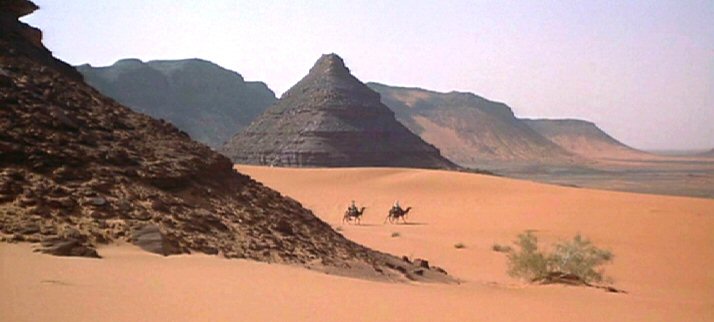
This clip is about 3 minutes long, but you could get by on just watching the first minute and ten seconds. Lawrence of Arabia is acclaimed for its cinematography and beautiful setting. But is that all the natural elements are? Setting? Consider this quote from Martin Lefebvre:

"The birth of landscape should really be understood as the birth of a way of seeing, the birth of a gaze by which what was once in the margin has now come to take its place at the centre."

I argue that narrative prioritizes action and plot while consideration of aesthetics requires a pause, an introversion that steps aside from story. It is on the side of aesthetics that we should place landscapes.

But as you watch this clip from Lawrence of Arabia, does your mind stay aesthetically tuned? Or does it seek out plot as well?

Again, Martin Lefebvre says: "Landscape in narrative film possesses the peculiar ability to appear and disappear before the spectator's very eyes."

So, please watch this clip, and respond as you see fit. Gut responses are fine, because part of what I'm arguing is what landscapes do to us without us realizing it. If you'd like some question prompts, here are a few:

1. What do you think is the meaning of the clip in the first minute?
2. What attracts your attention?
3. Are you more or less engaged in the scene in the first minute, compared to the bits of plot that follow shortly thereafter?
4. What is the difference in your experience of watching the clip before the introduction of plot elements, and after?
5. What do you think about or wonder as you watch the first minute? What do you think about or wonder after the plot elements have been introduced?
6. Does your "view" or "gaze" change over time as the video clip plays?

Here is the video clip:


If you'd like to be able to watch the clip larger, here's the link to the youtube clip "Great Moments of movie music 2." The title obviously suggests I should also be thinking about sound and music...which you can also feel free to comment on.