Showing posts with label Martin Lefebvre. Show all posts

Saturday, June 12, 2010

Landscape: made of 0's and 1's?


This post follows up my new hub post in which I articulate 3 new areas of exploration, with this post focusing on how the analogy of landscape might be applicable in the digital context.

My classmate, Ben, and my professor, Dr. Burton, commented on my new hub post with the appropriateness of "landscape" as an analogy, and suggested another film term to consider: Mise-en-scene.

The appropriateness of "mise-en-scene"
"Mise-en-scene" has been called film's "grand undefined term," because of different opinions about its scope, but a quick, narrow definition of mise-en-scene follows: "everything that appears before the camera and its arrangement - set, props, actors, costumes, lighting." In other words, in its narrow definition, it refers to things that are arranged by the film-maker, to give a certain mood, tone, or look to a scene.

Dr. Burton suggested the appropriateness of "mise-en scene" for the digital realm because it is "artificially composed." I like that, but I have a few things to say about landscape that might still justify the comparison.

The appropriateness of "landscape"
According to Martin Lefebvre, "landscape" can be contrasted to "nature" in the sense that it is man's "interaction with nature and environment that produces the landscape." In other words, the "landscape view" is one that directs an intentional gaze at nature, transforming it at least in part by the very eyes that behold it.

So how could "landscape" still be more useful than "mise-en-scene" as an analogy? Mise-en-scene implies that a film-maker put things in the frame for a specific purpose, whereas having a "landscape view" considers a broad vista which is much larger than oneself, and transforms it by looking at it in a certain way. Despite the artificiality of the internet, for instance, it was certainly not created by Al Gore nor any other single person, or even by a finite group of people. For any individual considering the scope and complexity of the data streams coursing through servers and individual computers, the internet may as well be a thing as vast, sublime (see my classmates Andrew, Chris and Katherine's thoughts on the sublime in new media) and removed from a single individual's influence as "nature." But, a single individual can choose to consider the complexity of the internet in a certain way - to begin to organize it conceptually by applying the "landscape gaze" to it - which is what search engines and other data organizers do.

Another way of thinking about a way that the internet may be considered using the "landscape view" is that the internet, by definition, connects information that would otherwise sit isolated in a location somewhere. But by applying an intentional "view" of connectedness, the internet transformed all of that isolated information into a broad vista of information, and provided tools with which to craft it into forms useful for mankind, much as "landscape" does with "nature."


Saturday, June 5, 2010

Tom Gunning: Setting me straight


My "Writing About Literature" professor, Dr. Burton, asked that we extend our research process beyond our own isolated bubble, so that we could better take part in a larger conversation about our research topics, and learn to make connections that will allow us to grow through collaboration. So, I decided to send an e-mail to the superstar of silent film scholarship, Tom Gunning.

Tom Gunning is the Chair for the Department of Cinema and Media Studies at The University of Chicago, and is "famous" for creating a new way of looking at pre-feature silent films, which he terms "the cinema of attractions." The following is an excerpt from his Bio on UChicago's faculty page (along with a great Bio pic):

His published work (approximately one hundred publications) has concentrated on early cinema (from its origins to the WW I) as well as on the culture of modernity from which cinema arose (relating it to still photography, stage melodrama, magic lantern shows, as well as wider cultural concerns such as the tracking of criminals, the World Expositions, and Spiritualism). His concept of the "cinema of attractions" has tried to relate the development of cinema to other forces than storytelling, such as new experiences of space and time in modernity, and an emerging modern visual culture.


I decided to send Dr. Gunning an e-mail with a question that I had been researching but could not find an answer for. Here is the e-mail:

Dr. Gunning,

I am a double Film and English Major at Brigham Young University. I don't presume that you respond to e-mails from anonymous students; but as I'm working on a project in your area of expertise, I finally decided that it was worth giving it a shot.

I have spent some time following the work you have done, especially in early silent film. About a year ago I found Martin Lefebvre's volume "Landscape and Film," which you contributed to, and have since learned about your work with what you term the "cinema of attractions." It was an exciting experience to realize that there is still a fairly current and evolving discussion about film, even in its classic stage, and it is a dream of mine to contribute to it myself.

My specific interest is in landscape and film, and I know that you have spent time looking at D.W. Griffith and landscape in particular. I am currently revising a paper I hope to find publication for about Victor Sjostrom and the "landscape view," as I was sharply struck by Sjostrom's use of landscape (seascape) in Terje Vigen (A Man There Was - 1917), and The Outlaw and his Wife(1918). I am formulating a paper that suggests that these two films of Sjostrom's may form a model that we might benefit from today.

One specific question I have is whether Sjostrom was diverging from common practice by shooting such striking, poignant scenes out in nature, as opposed to in the studio. I have extrapolated that most producers would choose to shoot big-budget films on a set in a studio because it would be cheaper than moving a whole film crew to a natural location...and that the studio system was really coming into its own during just this period...but have not found definitive proof for this in the research that I have conducted.

Whether you find the opportunity to respond to this e-mail or not, I wanted to express my admiration for the work that you have done.

Best,
Neal Call


About an hour later, I realized that I'd made a mistake in my e-mail (aw suck!), and sent Dr. Gunning a second e-mail apologizing:

As I was looking at Martin Lefebvre's book again, I realized that it was Jean Mottet who wrote an article about landscape in D.W. Griffith. It doesn't alter my interest in your work, but I apologize for misrepresenting. I just knew that you had done work with the early American film and D.W. Griffith.


Despite my silly mistake, Dr. Gunning responded almost immediately with an answer that probably saved me 5-10 extra hours of research trying to find evidence for something that didn't exist (and I'd spent that much time already trying to find it). Here is his response e-mail:

Dear Neal

A quick answer. In the teens when Sjostrom was working, shooting in a big studio for landscape scenes was not necessarily cheaper, so it was not unusual for directors of the teens to shoot landscape scene sin nature (Griffith, prodcuer Tomas Ince and the various directors who worked under him) Maurice Tourneur, all did great work in landscapes, However I would agree Sjostrom was perhaps more powerful than any of the others, not because he was the only one shoorting in landscape, but because he has such an extraordinary sense of the way environment interpenetrated his character and his narrative. Outlaw is perhaps the masterpiece in this regard, but most of his films show this great sensibility. It may partly be a cultural sensibility, since I feel the strongest rival to his talent in this regard is his fellow Swede Maurice Stiller, especially Song of the Scarlet Flower and (available on DVD) Sir Arne's Treasure I have an essay on Sjostorm, but it is not on one of his landscape films: “‘A Dangerous Pledge’: Victor Sjöström’s Unknown Masterpiece Mästerman” in Nordic Explorations: Film Before 1930 ed. John Fullerton and Jan Olsson (Sydney: John Libbey and Co., 1999).

yours

Tom Gunning


And Dr. Gunning's response to my flub of attributing his work:

Dear Neal

I did wonder, but if you look at my Griffith book you will find pleanty on Landscape...

yours

TRG


You'll note that Dr. Gunning directly refutes much of what I wrote in my second post on landscape in film, but I am overjoyed that he did, because I knew that I was making a leap without enough proof. Now I can revise it to make it accurate. Even better, though, was that he corroborated my sense that Sjostrom did something special that other film-makers were not doing - he in essence justified my paper, even if he offered a concrete counter to a sub-argument. All things considered, it was an excellent exchange, and if I can come up with another good, concise question to ask, I hope Dr. Gunning might offer me another pearl or two.

Tuesday, June 1, 2010

Landscape and Narrative: Using Victor Sjostrom's Early Films as a Case Study


This post forms the "head" for an exploration of landscape in narrative, and with a heavy emphasis on narrative in film. While many of my arguments stem from a close look at the use of landscape in Victor Sjostrom's silent films, they use elements of Sjostrom's films also as illustrations of what landscape generally can do within the context of the moving image, the motion picture. Why use Victor Sjostrom's work? Partly I have a desire to see his name fixed more prominently amongst the great filmmakers of our age; many are familiar with D. W. Griffith, Charlie Chaplin, etc, but Sjostrom rarely enters prominently into a discussion of the early great auteur filmmakers. Nevertheless, Andrew Sarris (the man who popularized the "auteur theory" in America) wrote of Victor Sjostrom that he was possibly "the world's first great director, even before Chaplin and Griffith." Why was he great? Sjostrom came to film from the theatre, and developed characters and situations that had great depth and emotional significance, as with one of his first acclaimed works, the 1913 film Ingeborg Holm. But in addition to Sjostrom's nuanced sensibilities about character and story, he also introduced natural elements into his films that brought the spectacle of the natural world to a level rarely achieved before, or after. His films A Man There Was and The Outlaw and His Wife, released in 1917 and 1918, were at the time described as "the most beautiful films in the world." Sjostrom brought subtlety and beauty to the mise en scene of the natural world, surpassing the sort of place-holding role that setting and set design had been relegated to in a transitional period between the prominence of a "cinema of attractions" and the triumph of the feature film. Consider the opening sequence of A Man There Was, and how powerfully Sjostrom uses the natural world (and note that it is Victor Sjostrom himself in the title roll):


I am a lover of outdoor spaces, of big skies and distant horizons, of the sublime grandeur of mountain ranges and the infinite repetition of waves in a choppy sea. And while this love is personal, and forms the impetus for my exploration of landscape in media, it is also communal, as it follows a general societal impulse to see the world's awe-inspiring natural locations, whether in person or vicariously through whatever medium may be available. We can find, for instance, in an early silent film produced by
Thomas Edison, a short film of a natural setting in which no specific action takes place other than the motion of the train and of the water roaring by in the gorge outside the train's windows.


Audiences flocked to see these types of films, called "phantom rides," "scenics," "travel films," "travelogues," or "foreign views." There are clearly echoes of the "travel film" in
A Man There Was...but Sjostrom takes the camera's ability to capture natural spectacle and weaves it into a story that uniquely benefits from the union. He did this at a time when many films had removed from natural settings, because of the expense of transporting actors and film crew and for concerns about weather and disruption of extremely tight shooting schedules.

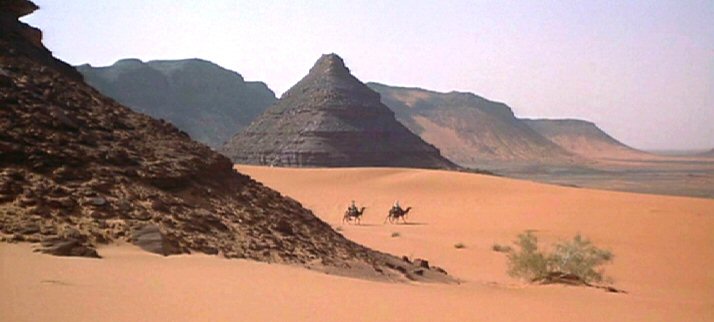
The many terms synonymous with "travel film" is indicative of the huge volume of such films that were produced in the early days of film, generating copious descriptions and labels. And it is clear that natural locations are still important in film, that they strike a chord in audiences in ways that deserve to be explored further. We might look at a scene from Lawrence of Arabia, for instance, and note the ways that the framed depictions of a desert world worked to create one of the most celebrated films of all time. In a more current example, we might consider moments from Baraka, a film that was filmed in 152 locations in 24 countries, and that was neither cheap nor easy to make.


Why make it? Because it was meaningful both for the filmmakers, and for the audience, just as Edison's film from 1900 was. The fact is, that along with narrative stories and action and events, both historical and modern audiences are drawn to landscapes.

The popular affinity for the grandeur of our world is a sensibility that Victor Sjostrom tapped into. But I argue that landscape in film is much more than a pretty thing to entrance us. Martin Lefebvre, Associate Professor in the Mel Oppenheim School of Cinema, Concordia University, Montreal and author of
Landscape and Film, says that "landscape is everywhere in film, but it has been largely overlooked in theory and criticism...What kind of landscape is cinematic landscape? How is cinematic landscape different from landscape painting?" Lefebvre poses such questions in his volume, and I hope to articulate a response that enriches the discussion. I also intend to note differences between the use of landscape in literature and the use of landscape in film.

Ultimately, it is my view that developing an understanding of the way landscape can work within a text will aid the modern viewer in determining valuable aspects of visual aesthetics, especially aesthetics in film. I also suggest that this understanding may help modern viewers to be reflective and discerning in consuming media, so that the viewing process is one of growth, rather than cheap thrills or stagnation.

The following points delineate the different areas that I will consider in my exploration of and arguments about landscape:

1. A historical look at the transition period between the "cinema of attractions" and the feature film
2. The biography of Victor Sjostrom and the events that led him to consider his natural environment as an important aspect of his films.
3. A comparison using film clips of Victor Sjostrom's films and representative films of the same time period.
4. A historical look at the way that landscape has developed in art and literature, and in film, and an analysis of the differences between them.
5. An extrapolation of Roland Barthes' thoughts about "Readerly" and "Writerly" texts to the film paradigm, and the ways that landscapes can promote the creation of a "writerly" text.
6. Personal experiences in creation of landscape painting and film that inform my thoughts about landscape
7. Theorists and texts that might add to the discussion that I have not yet explored.

Edit 6/15/2010: I reformulated ideas generated in this exploration in a new hub-post that crystallized my thinking and went in some new directions.

Friday, May 28, 2010

People who I disagree with


I am still struggling to rip the scenes I need from My Sjostrom DVD, so in the meantime I'll share a bit about landscapes from two online writers that I disagree with.

To start, I found Stewart McKie's article on Sys-Con Media, titled "The Role of Landscape in Film." He lists some of my favorite movies: Lawrence of Arabia, Dances with Wolves, Aguirre: The Wrath of God, etc., and goes on to describe the ways in which the landscapes within them "add additional depth to a story or the situation that characters find themselves in." I don't have a problem with that statement. In fact, I'd agree with most of what McKie says, when he includes a list of ways that landscapes can work in film:

  • Reinforce themes
  • "Raise the stakes"
  • Create emotional highs
  • Emphasise contrasting worlds
  • Act as a character in its own right

But he leaves out an important element that I think Martin Lefebvre is keen to observe in the introduction to his volume, "Landscape and Film." Lefebvre's essential addition is that observation of landscapes often results in a removal or break from the narrative, because it privileges the aesthetics over the plot. McKie only discusses landscapes in ways that are more immersive to the viewer in the world of the story, if not the story itself. He sees landscapes not as opportunities for pause from narrative, but as extra tools to maintain the film's pull on the viewer, to root them in the story. I don't deny that what McKie says can happen, but I don't think landscape is always or merely an immersive element.

Yet again as I sought another online writer, I found Renee, a blogger and film-maker who again sees landscape as an opportunity to latch ever more strongly to the "world" or "atmosphere" of the story. In her case, she speaks of having worked on the movie "Twilight" as a painter, and discovered the ways that landscapes were so powerful to people. There is a real town called "Forks" on which Twilight fans have descended, because as Renee puts it, the land and landscape are a way to "enter into the story through a real-world portal." And that's something they tried to recreate on the set of Twilight.

So I'm bumped up against the question that challenges my assertion: Does landscape really immerse us more in the story, or does it offer us an opportunity to step back from it? Or both?