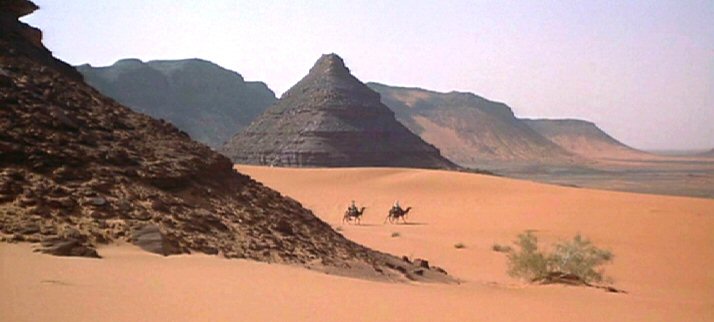
This is my last post in a series looking at the way landscape functions in film. To see the journey and how it has evolved, look at my first hub post, and then my reformulated hub-post that concludes with thoughts left here.
A Recap of My Last Post
In my last post, I spoke about the ways in which natural elements in movies have been used as a way of "transporting" us to another world, creating an "immersive" experience that can capture the viewer's attention, and not allow additional moments for reflection. I used "Avatar" as a prime example, and showed its trailer which employed the typical attention-grabbing techniques. We might ask ourselves whether the trailer actually made use of "landscape," as I defined it in a blog post under my older hub, in which landscape is differentiated from "nature" and from "setting." In the trailer, perhaps the pace was such that the natural setting never had a chance to emerge from the margins to take its place as the focus of attention.Also in my last post, Andrew made a comment that questioned my use of the trailer as an example. I think he makes a good point that the trailer pushes an extreme...but it makes my point. There well may be extended uses of landscape in the film Avatar, but it will be up to future viewers to make that decision, and to decide whether that movie provides the space within which to reflect, or whether even the uses of natural settings are only shown long enough to entrance and immerse, but not to reflect.
P.S. You'll want to click on this last image
My Limitations
I don't think that I have a neat formulation of what line we may form between "setting" and "landscape," partly because the "landscape view," is dependent upon the viewer to have, at the moment that he or she chooses it. Nevertheless, we may say that the natural elements indicated in the Avatar trailer certainly allow little time for a "landscape view" to arise.
Back to My Main Text, and Why Landscape Matters
What would be a film on the other end? I refer here back to the literature that inspired my musings on landscape in film: Victor Sjostrom's Terje Vigen.
In this clip, a man rows to save a family stranded in a sinking ship. The scene is full of emotional tension, and certainly that influences the way that one will see the natural elements. But one of the things that most markedly differentiates between this clip and the trailer from Avatar, is the duration of the shot, that allows the viewer to understand the action occuring in the scene well enough to spend time considering the aesthetic properties of the sea, thus creating "landscape." The aesthetics of the "landscape view" are further accentuated by the naturally engaging rhythms of the wind-blown waves. A viewer might spend those moments of aesthetic consideration any number of ways: mesmerized by the "motion of the ocean," or recalling a childhood experience on the beach, or perhaps even (as I did) pondering about the authenticity of the churning waves as a backdrop for a fictional film. The former engaged my thought process, not by entrancing me, but by demonstrating to me the juxtaposition of a fictional narrative with something that (for me) transcended even the story being told, because of its authenticity, because of this "landscape," or "seascape" being so much more than an artificially constructed set, but rather something that existed before the making of the film, almost eternally.
Barthes and the Readerly/Writerly Perspective
In a 1983 article in Sight and Sound just following Roland Barthes death, the critic Jonathan Rosenbaum wrote a short review of what he perceived to be Barthes' views on film. He described Barthes as "mistrusting the hypnotic spell exerted by cinema," and at the same time saying that "the best films are those that suspend meaning the most..." Rosenbaum explains that such a film would "jolt" the viewer "profoundly," corresponding with what Barthes had also written about "writerly texts - the kinds that refuse easy understanding and are hard work to get through. See Barthes' S/Z for more background.My relation of landscape to Barthes' ideas about "readerly" and "writerly" texts refers not to that "jolt" supplied almost forcefully by the difficult, uncomfortable text(film), but rather to what Barthes writes about the ability of a consumer to create "writerly" texts from a text that is "readerly." By nature, a film pulls along the viewer according to a predetermined pace, and in many ways filmic narratives might be considered in the "readerly" category, unless through story or spectacle they seek to deliberately "jolt" the consumer, rather than entrance or immerse. And because of that same pacing, it might be difficult for a viewer to deliberately create what Barthes calls "edges" in a text, by skimming, flipping pages, or reading out of order as one might do with a book (of course, I must point out that I am referring to a theatre-type viewing, in which the viewer has no control over the showing of the film). But when we have shots as in the above clip from Terje Vigen, the length of time dwelling on the landscape images, without the intercession of flashy film techniques like panning, zooming, tracking, quick editing, aggressive sound track or sound effects, etc, allows an opportunity for the viewer to create the edges that Barthes talks about; the lingering nature of the landscape allows the viewer, should he so choose, to find a "writerly" moment in a text that would often otherwise be "readerly."
Concluding Thoughts
This, ultimately, is the driving force behind my exploration of landscape as Victor Sjostrom used it, and in film in general. It is not an exhaustive proof, and certainly does not detail in much thoroughness the ways that film grammar functions in film, nor does it extend my hypothesis into a much-needed survey of films including natural elements to determine accuracy. Nevertheless, I hope that my use of media in this blog has provided enough concrete evidence for at least a thoughtful question to be posed, even if my answers are inadequate. To the reader who would continue this exploration, may you journey thoughtfully into the sunset-drenched horizon, and may you develop your own, individual ideas about landscape.
P.S. You'll want to click on this last image